Wednesday, August 7, 2013

#4

Pablo Neruda's personal barroom. Isla Negra.

Monday, July 29, 2013

Autumn in the vineyard


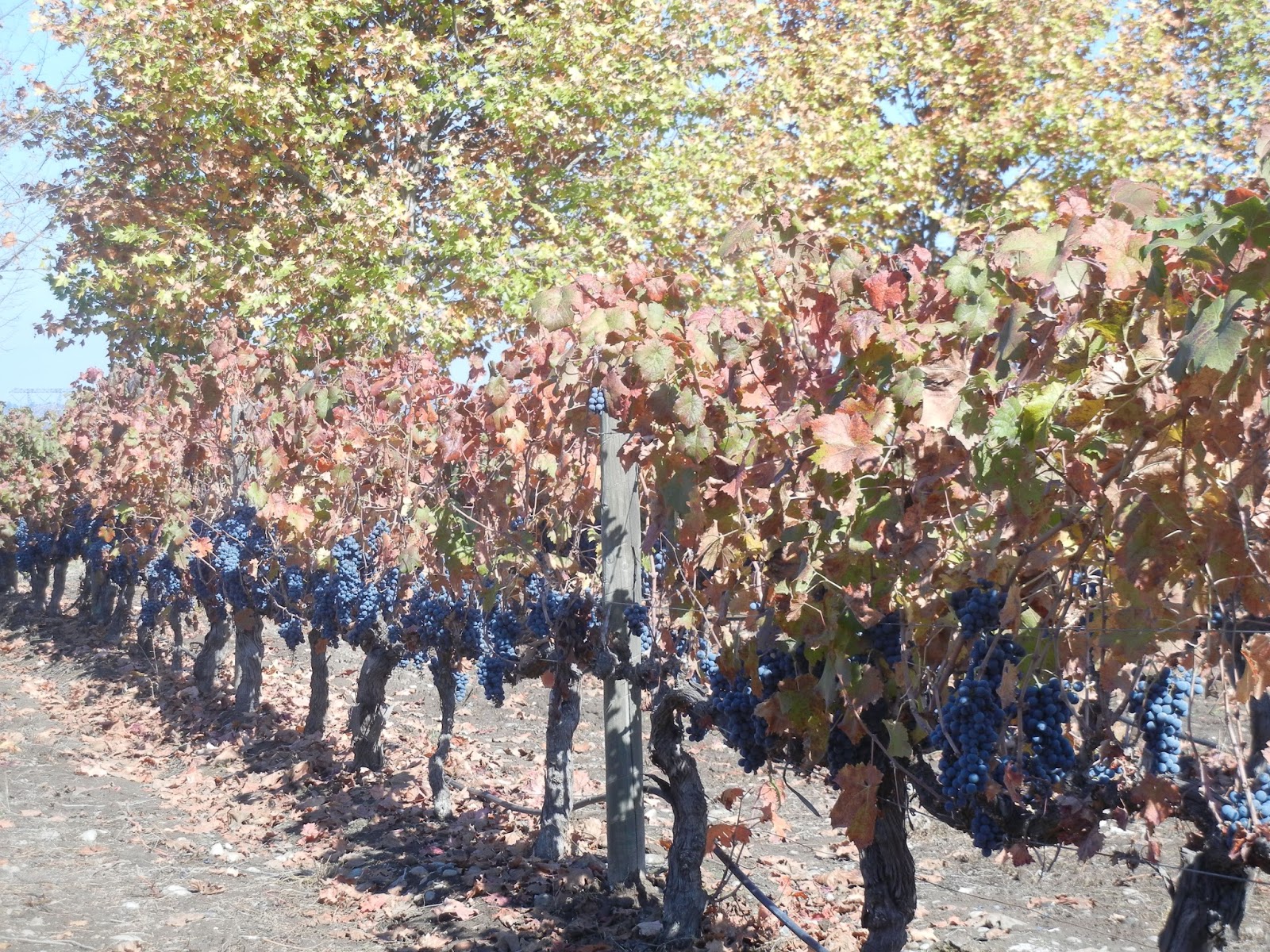
During the recent visit of my sister-in-law, we had the chance to get out of the city for a couple of days, and being late Fall at the time, it seemed like the perfect opportunity to visit one of the countless vineyards near Santiago, before all the grapes were gone from the vines. We took a train to the Cachapoal valley, about 45 minutes south of the city. Our destination was the viña Anakena. Their wine is one of the more common ones you can find in Santiago, and over the years I've found myself buying it again and again for a consistently drinkable and flavorful bottle. At 3000 pesos ($6) their standard reserva is a great go-to wine for dinner or a party.

One of the almost universal qualities of visiting any vineyard is the chance to spend time in a rural setting, surrounded by wide open spaces. And since grapes thrive in a Mediterranean climate, that usually means blue skies and warm sun as well, even on a late Autumn day.

Many vineyards take advantage of this fact by setting aside some area on their property in order to enjoy the sublime setting. Anakena, for example, features a small pond with an open field next to it, in addition to an indoor space designed for events like weddings or business conferences.

Any tour of a vineyard naturally begins with a walk among the rows of grapevines. We went in May, quite late in the autumn harvest season, but we were lucky to find quite a few grapes left on the vines, which we were invited to sample. I can't say that I've tried many fresh grapes of the wine-making varieties, nor that I have anything close to an expert's palate when it comes to appreciating the finest subtleties of grape and wine flavors. With that caveat, I'll tell you that I was very surprised to discover that the several fresh wine grapes that we tried were, while delicious and varied, not particularly exceptional in their flavor for me, compared to other high quality table grapes I've sampled in the past. I don't know what I was expecting from a wine grape compared to a table grape, but whatever I was hoping to taste, I didn't quite get it.

Our tour guide for the day didn't go into great detail explaining what characteristics contribute to the selection and cultivation of the many wine grapes we enjoy today. But I imagine in addition to flavor are other qualities such as color, as well as various chemical compositions that contribute to good fermentation, and what have you.

We were taken along several rows of grapevines, each helpfully labeled to identify that particular grape we would be trying.

While I don't specifically recall the contrasts in taste, texture, color or juiciness of each grape that I tasted that day, I can say that I was impressed by the great range in flavors from one variety to the next. While some were exceptionally sweet, others were very acidic and even bitter. We were told that classic French reds such as the Cabernet Sauvignon and Merlot,as well as the now distinctively Chilean Carmenere, did particularly well in the climate of the Cachapoal valley.

Endless rows of grapevines framed by woods and graced with the water runoff from the mountains of the Cordillera de los Andes on the horizon. A truly beautiful place to learn a thing or two about winemaking.

The second part of the tour took us to the commercial facilities of the vineyard. Here we saw a modern operation including the mechanized mashing of grapes.


We also had the chance to see these huge vats used for the fermentation of the grape juice, as well as an automated bottling facility, which was not in operation at the time. Our guide told us that the vineyard even leases their bottling operation to other vineyards lacking their own such machinery.


The last leg of the tour of the facilities took us to the barrel room, where you can see the wine reposing in oaken casks, full up to their purple-stained bungholes (that's what they're called).

Here is where the wine mellows with age, and also begins to take on some of those deeper flavors imparted from contact with the oak itself.


The climax of the tour came with the tasting of some of the wine we'd been tantalized with throughout the afternoon. While far from a connoisseur of wine, I benefited greatly from a quick lesson on getting the most out of a glass of wine. From analyzing the color to noting the aroma in a gradual way before taking the first sip, we were shown a short list of simple techniques to aid in the appreciation of any wine that fills your glass.

We sampled three wines before being let loose in the obligatory gift shop where the tasting took place. We were also offered some very low prices on a few of Anakena's premium bottles, which we couldn't pass up.

All in all, a fine foray into the world of winemaking. With another trip planned to visit some other vineyards in a valley a bit further to the south in September, I hope to have a few more insights to share before long.


Tuesday, July 23, 2013

#3

Palafito, "stilt house" of Castro, Isla Grande de Chiloé


Tuesday, July 16, 2013

#2

Procession in Plaza de Armas, Feast of Our Lady of Mount Carmel

Monday, July 8, 2013

#1

Cordillera de los Andes, taken from the terrace of the Santiago Library, Barrio Brasil

Sunday, June 30, 2013

Mystic valley

Valle de Elqui was the last stop on our trip to el norte chico of Chile. As you travel north from Santiago the landscape grows drier and drier, punctuated by valleys made green by virtue of the rivers and resulting agricultural activity of the area. The Elqui Valley is famous for its production of pisco, a distilled spirit made from grapes, usually mixed into cocktails such as piscola (pisco and coke) or pisco sour. As you head up the long valley east from La Serena, the dry hills are lined by the continuous strip of green vineyards whose produce is destined for the pisco bottle. So significant to the local economy is pisco that the town we were bound for goes by the name Pisco Elqui, changed from the less descriptive name of La Unión in the 1930's.

We rented a cabin about a kilometer outside of the town itself, with views over the irrigated vineyards spreading out across the valley floor. Being early Spring, many of them had not yet put out their leaves; I imagine by December the valley is quite a bit greener.  The hillsides, by contrast, are perpetually brown and barren, belying the arid climate of the region.  Sights such as this one demonstrate how essential the river is for life in this part of Chile.


Our cabin was one of several on a small property outfitted with some grills for barbecue, a pool (albeit with water a little too cold for swimming at that time of year), a bar, and some nice common areas to enjoy the sublime climate of the area. With its crisp, clean desert air, Pisco Elqui is a fine place to sit in the cool shade and contemplate the eternal hillsides. In fact, the Elqui Valley is at least as famous for its mystical qualities as it is for its pisco. Several communes are to be found in the area, and the various towns dotting the valley all have an undercurrent at times hippy, at others new age.

At night the temperatures drop quickly, and an impressive panoply of stars emerge in the clear, black sky.  Due to its low humidity, low population and therefore low level of light pollution, the area is also well-regarded for its potential for astronomical observation.  Several high-powered telescopes are located near La Serena, and some observatories even open their doors for tourism.  We didn't manage to see any of them for ourselves, what with the late night tour schedules and our 3 year old companion's early bedtime, but we did enjoy the starry nights, all the same.

As time has gone on we've developed a preference for staying in apartments and private cabins during our travels. Both options give us access to our own kitchen during our stay, which is what has always attracted me to staying in hostels in the past. Going out to eat is one of the pleasures of vacation, but it's also nice (and much cheaper) to be able to cook in the comfort of your own accommodations when you choose to. But if you compare the cost of a private apartment or cabin to that of a private room in a hostel, at least in South America, the prices end up being about the same. All things considered, we've ended up appreciating the privacy we get from having a space to call our own while we travel.

The town of Pisco Elqui is made up of just a few winding, dusty roads lined by old, single story brick houses. A quiet town animated by tourism, especially the during the fiestas patrias of September.  While we were there, the streets were decked out with Chilean flags and red, white and blue banners and ribbons everywhere you looked.

The town square is graced with restaurants bustling with clients, and street vendors selling everything from crystals to coffee mugs.  In the square itself, young South American travelers play guitar and wonder where they'll spend the night.

Besides the simple act of relaxing and enjoying the peace and quiet of the valley, the main tourist attraction of Pisco Elqui is the Mistral Distillery.  It's named after Chile's 1st Nobel laureate - and the first Latin American to win the Nobel Prize for Literature - Gabriela Mistral. While not born in Pisco Elqui, she was born just down the road, in Vicuña. Vicuña already has the Capel distillery, which cranks out a cheaper and more commercial pisco, so the Mistral name was up for grabs. Here we see big fermentation tanks, where yeast has its way with grape juice under a controlled environment, producing alcohol, carbon dioxide, and warm air. And in the foreground is, for dramatic effect, an old barrel.

As an occasional beer brewer, I can wrap my head around fermentation. I've studied and observed how yeast can have a profound transformative effect on a sweet solution, bubbling, churning up sugar molecules into alcohol. It will never cease to amaze and impress me, but I've seen it. I get how it works. Distillation, on the other hand, remains something of a sublime mystery. The vocabulary surrounding it adds to the riddle: Alembic. Retort. Still. Liquor. Esters. Spirits. All evoke an alchemy as much magic as science, and yield a product deserving of respect and admiration, as much for the potent effect it can have as an imbibe as for the time, patience and care it took to create.

Sure, I can grasp on an intellectual level the dynamics involved in separating alcohol from water. That is one thing. It is another to be part of the process, to catch a whiff or glance of some rich concentration of the essence of the grape. In the few cases when I've had the opportunity to visit a distillery, I've yet to be lucky enough to observe the distillation process itself, in action. To see what goes on inside that fat-bellied vat through a glass porthole and try to understand on a more visceral level what it is. These, like all the others I've seen, were empty.

While our little group was unable to observe the process directly, we were privy to the finished product at the end of the tour. Commemorative stemware in hand, surrounded by barrels of pisco in repose, we tasted sip after sip of Destilería Mistral's various offerings, from the youngest to the most premium bottle they produce. I will admit, I'm not a fan of pisco. I've tried, but it's simply not a liquor I can appreciate. While I can accept it as a respectable ingredient in a cocktail, I have never been able to find a pisco that has been palatable straight up, either to shoot or to sip.

Over time I've lined up liquor mentally into two columns, with tequila, mezcal, rum, vodka, and to a lesser extent, whiskey and even raw aguardiente as tasty, attainable drinks with stand up flavors of their own, if you can find the right bottle, on one side. On the other unapproachable one lie gin and pisco, among others, which I can't seem to get my palate around. Maybe I just haven't found the right bottle yet. I'm willing to keep an open mind.

The picture here reveals another quality I've come to appreciate in tours of distilleries, which is the fanciful atmosphere each one unfailingly manages to craft, from ancient alembics on display, consistently impressive facilities and location, and as seen here, creative ways to dispose of old barrels.

All in all, our time in the Valle de Elqui was a fine experience. We greatly enjoyed the town of Pisco Elqui, and in the three days and two nights we spent there, we were able to do, see, and experience much of what it is as a community. My only wish, as is always the case at the end of a trip to a new place, is that we could have seen more. The valley is home to many towns, each with its own character. As you go even further upstream the roads narrow and the towns at the end of them, or so I've heard, are even more peaceful, authentic, and uniquely characteristic of the region.


Sunday, May 26, 2013

Coquimbo, and a big party


Close to La Serena in the "short North," (el Norte chico) of Chile, situated on the south end of a calm bay, is the port city of Coquimbo.  It's so close to La Serena, in fact, that it has always vied with its nearby neighbor for prominence in the region, much as Valparaíso does with Viña del Mar along the coast nearer to Santiago.  La Serena is much older than Coquimbo, and today is much more recognized as a tourist destination.  Coquimbo, for its part, is an important center of shipping for the 4th region of Chile, and has even lent its name to the area, also known as the region of Coquimbo.

Because of its history as a port, it received a lot of European immigration in the 1800's much as Valparaíso did.  It's not as recognized for this fact as Valpo, but today you can still find sections of the city with the same kind of architecture you'll find in Valparaíso's hilly historic districts.  Granted, there aren't as many old buildings as Chile's more famous port to the south, and Coquimbo doesn't receive nearly as much tourism, but if you pay a visit to La Serena it's well worth the time to spend an afternoon in el barrio inglés, and then take a walk down to nicely renovated costanera on the seafront.

From there you get a nice view of the sea, the many ships waiting in harbor, the city of La Serena across the bay, and the green hills pictured above.  But if you turn your back to the seafront, you are also treated to a nice view of the city of Coquimbo itself.  Then you realize that the comparison of Valparaíso and Coquimbo doesn't stop with their shared history as ports.  Coquimbo's geography is much like Valpo's, with the city spilling onto and over the hills surrounding the bay.  In many ways - geographically, as a port, for its historic center - Coquimbo can be considered something of a Valparaíso in miniature.

But if there's one thing that sets Coquimbo apart from any other city in Chile, it is the pampilla.  A huge outdoor festival taking place during the fiestas patrias of Chile for several days around September 18th, people flock to Coquimbo to camp, buy, sell, eat, and drink.  Across the open field you can see countless tents set up to form a temporary city, with an estimated 100,000 people or more, coming for the day or for several days in a row.


The city of Coquimbo itself, in fact, was very quiet that day, and many stores and restaurants were closed.  That's because, during the fiestas patrias, so many people relocate from the city to the pampilla.  Individuals, but also businesses.  Restaurants and clothing stores set up outdoor stands.  But also hardware stores, real estate agencies, electronics sellers.  The pampilla concentrates the entire spectrum of humanity into a glorious spectacle of sun-drenched revelry.  Have a beer, have another.  Eat some barbecued meat, and why not?  Buy a power saw, or your next apartment!

We stayed at the pampilla long enough to share a pitcher of beer and lunch fresh off the grill, and left before the sun went down.  As fun as it was, we got the idea after a few laps around the main rows of restaurants and shops.  We never saw the crowning of the pampilla's beauty queen, or any of the live music going on at the main stage.  But I did pick up a bottle of chicha, a sweet, fizzy, boozy, fermented grape juice on the way out.  That way we could keep the party going in our own quiet way back in La Serena, and let things go as they would, with or without us, back in Coquimbo.