Showing posts with label Wine. Show all posts

Saturday, March 29, 2014

The Colchagua Valley


During the September 18 Fiestas Patrias last year, we decided to take a train to the Valle de Colchagua. Several of Chile's central valleys have been given over to vineyards, and the Colchagua Valley in particular has gained international renown due to some award-winning wines that have begun to emerge in recent years from this region. September in Colchagua is the last month of winter, and during the first day of our stay we had overcast skies and cool weather. Also, being the end of the rainy season, we were able to enjoy the valley at one of its greenest times of the year. Much like southern and central California, for many months of the year, central Chile receives very little rain, and as a result the valleys, hills and mountains are rarely as green as they are at the end of winter.

Conversely, being the very beginning of the agricultural season, the vineyards themselves were still barren of leaves. As the progressively drier spring and summer wear on in this part of Chile, the landscape changes from green to golden, and ultimately, brown. At the same time, the irrigated basins of Chile's valleys stay a radiant green, ultimately producing much of the fruit that the rest of the world enjoys throughout the northern winter.


Central Chile, bounded by the Cordillera de los Andes to the East, the Atacama Desert to the North, Patagonia to the South, and the Pacific Ocean to the West, enjoys what may be a unique natural isolation compared to any other agricultural zone in the world. Due to this, many of the pests and diseases that have ravaged various types of grapes and other produce have never been able to reach this part of the world. Now that the country is ever more open to global trade, Chilean customs officials work very hard to prevent foreign agricultural products from entering the country, even those brought in by tourists arriving across borders by air or land. As a result, there is for example a variety of grape known as Carménère, which was almost completely devastated decades ago in its native France by a type of fly and is now almost exclusively produced in Chile.

The first vineyard we visited was, as you can see, Viu Manent. We've visited vineyards before, and to a certain extent, once you've toured a vineyard and seen the various stages in the wine making process, the information you receive on subsequent tours will start to become a bit repetitive. That said, each visit to different vineyards during our time here in Chile has continued to hold our interest and reveal more to us about the subtleties of different methods and scales of production. Every vineyard is unique not only in its wine-making practices, but also in the treatment of the tourists who come to visit.

Vineyards are large places, necessarily occupying many hectares in order to grow enough grapes for commercial production. So how to provide a close-up look for tourists of both your facilities and your fields, especially if they are located far apart on your estate? One solution several vineyards have adopted is to plant a selection of vines bearing all of your different varieties of grapes in one place for tourists to see and sample conveniently. Others, like Viu Manent, have found another way. If you have to move people across a long distance, why not move them in style?

Rather than show you the fermentation tanks and barrel room of Viu Manent, I'll refer you to the experience we had in the Cachapoal Valley. After all, while there are difference in production methods, barrels and tanks end up looking much the same. What is always distinctive in each vineyard, however, is the tasting of the finished product. From the presentation of the wine to the wine itself, it's always a joy to sample a bit of the wine that you've been learning about during the tour, and to afterwards, to select a few choice bottles to take home with you as well.

Another treat inherent in the visit to a vineyard is the fact that you are exploring what is, in essence, an expansive rural estate, often graced by historic buildings and the beautiful landscapes that are synonymous with the Mediterranean climate necessary for good wine production. Modern vineyards, while embracing the technology associated with commercial wineries, also invariably have one foot firmly planted in the past. From vines cultivated over the course of decades to wines aged in the controlled climate of a good cellar, the wine making process is steeped in time.

We'll save the rest of our trip for another post. Until the next time!


Tuesday, February 26, 2013

Harvest time

It's been awhile since I last posted.  What can I say, sometimes I get distracted.  But with the new year and summer vacation out of the way, I hope to get back into a fairly regular routine of blogging.  I'll be serving up a modest posting of a few short paragraphs and pics this time around, as a way to ease back into things.  Plus, with some luck this will prove to be something of a segue into next month's offering.


About this time last year we took a train to the town of Buin, south of Santiago and in the middle of Chile's heartland of vineyards.  Steeped in wine culture as Chile increasingly is, the time of the grape harvest is marked by festivities all around Chile's wine producing areas.  Buin is no exception, and being conveniently located on the rail line in close proximity to Santiago, it was a natural choice for our first harvest festival, known in Spanish as the vendimia.

The popular Chilean vendimia is fun for all ages, although probably much more so for those old enough to drink.  In addition to the obligatory sale and consumption of wine, there were plenty of other vendors selling food, especially cheese, olives and grilled meats, traditional favorites all of local production and fine accompaniments to your glass of wine de rigor.

In the background of this photo can be seen the stage, idle at the moment of shooting.  Soon thereafter however it became the scene of some good-natured stomping performed by young foreign women from the crowd, persuaded to come on stage and get leg-deep into shallow basins full of grapes. 

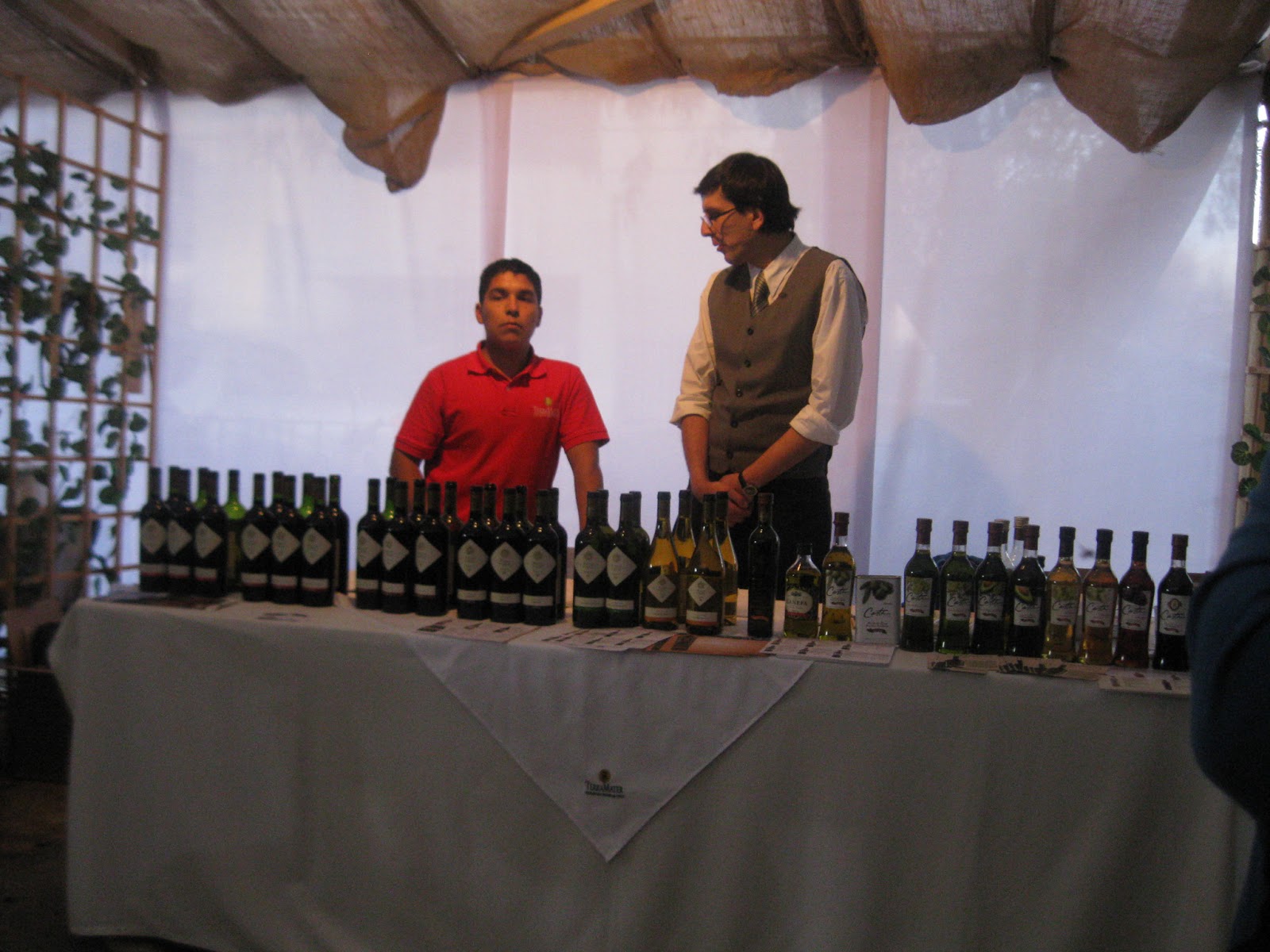
Having dispensed with the preliminary surveying of the grounds, it was time to roll up our sleeves and start appreciating some wine.  The two of us sampled four different wines each that day, always selecting vineyards theretofore unknown to us.

I have to say, unfortunately, that I was unimpressed by all of vineyards save one, Viña Richards.  If I remember correctly we had a Pinot Noir and a Sauvignon Blanc from them, and both were, in a word, tasty.  It's rare to find Pinot Noir in Chile, which was enough for us to gravitate towards it once we noticed it.

It didn't take so long for us to get through our four glasses of wine, moderately portioned as they were.  Afterwards we moved on to the grilled meat section of the festival, where we ate some shish kebab, known locally as anticucho, followed by some larger cuts of chicken and beef.  Damn, that's good!  From this particular angle you can see the meat skewers on the grill, as well as where you stick them once you've picked them clean.  Also featured is our daughter practicing cueca from an unorthodox sitting position.

It might seem antithetical to a celebration like this one, but I saw this brewing company on the way in, and couldn't resist picking up a pint draught on the way back out.  The stout was a fine finish to the evening and kept me occupied for most of the walk to the train station.


We concluded our evening with a sleepy train ride back to Santiago's nicely appointed Estación Central, which connects conveniently to a subway train taking us within two blocks of our apartment.  A fine way to travel, and best of all, the conductor is our designated driver.

You'll have to forgive the low light on this one, but I'd like to think it gives an indication of that soft, warm and fuzzy feeling you get when you ease into your seat on the night train.  It's getting to be vendimia time again in 2013, so I hope to share more soon.