Sunday, March 31, 2013

Ovalle, and a national park


Late last winter, during the famed 18 de septiembre holidays of Chile, we decided to head north.  Our ultimate destination was La Serena, but along the way we made a stop in a small agricultural community called Ovalle.

Chile's unique shape leads one to think linearly in terms of travel within the country.  With Santiago just about in the center of the country, unless you decide to hop in a plane the limits of your traveling will be predicated on how many hours you can stand to be on the road.  It's for that reason that many Chileans know their own country only as far north as La Serena or so, and as far south as Puerto Varas or Chiloé. That's about as far as most people are willing to drive at one stretch, and those with the money to fly often choose more distant destinations, such as Buenos Aires, Brazil, the Caribbean or other places in the US or Europe, rather than San Pedro de Atacama or Punta Arenas within their own country.

As travelers of modest means, those same limits apply to us as well, and the extremes of the Atacama Desert and rugged Patagonia are, so far, still unknown.  But once we set our sights as far north as La Serena, a little research turned up an oddity of a national park known as Fray Jorge along the coast near Ovalle.  Generally speaking, as you head north from Santiago the climate grows drier and drier, and to the south wetter and wetter.  But Fray Jorge is an exception, a dripping wet forest lying some 7 hours to the north of Santiago and surrounded by arid landscapes.  Why not check it out?

So we got a hotel in Ovalle and started looking for a way out to the coast.  It turns out there's no public transport heading there, and no rental car agencies in such a small rural town.  But a few taxi companies were scattered around the main strip, and boasted turismo among the variety of services proffered on their signs.  After some negotiating I was able to work out a reasonable price for a full day trip to Fray Jorge and another potential destination or two to be decided.  So after a night's rest with cable TV, we got in the backseat of an SUV and were on our way.

As we drove through the countryside, we saw some scenery atypical of the area, as our driver told us. The green hills all around were the result of some recent rain a few weeks before, provoking the light, bright coat of grass to sprout up around what was normally bare earth speckled with shrubs.  Like many arid climates, the vegetation is opportunistic and sprouts whenever moisture may come, regardless of the season.


But as we headed up the valley, the hills got higher and the green grass gave way increasingly to brown, until we reached the final geographic hurdle separating us from the coastline.  The line of hills pictured here in the background hold back moisture wafting in from the sea, which coalesces like clockwork every day against the hillside.  By virtue of that heavy blanket of precipitation the vegetation resembles forest seen normally only as far south as Valdivia, some 7 hours south of Santiago.  Also seen along those hills is a swatch of road which would carry us up and over to the other side.

There you have it.  Forest in the desert, how about that?  It was fun to walk around in the woods for a little while.  Our daughter hasn't had too much opportunity to do that in her short life so far, but every time she does, she has a great time.  This hike was well defined by a raised boardwalk, which made it tough to get lost.  Even though it was a bit slick from all the moisture literally dripping from the trees on many parts of the trail.

The cloud of mist hanging over the forest, known in an indigenous language of the area as camanchaca, is the source of moisture for many plants and animals living in the otherwise dry north of Chile.  Similar mists and fog blowing in from the coast grace the landscape of other parts of the northern deserts of Chile as well, and help to explain how any vegetation can exist at all in places with no rainfall in recorded history.


Apparently this forest was once more extensive than it currently is.  In fact, the area covered by real forest is actually pretty tiny.  While fog covers much of the surrounding area, the vegetation is low-lying along most of the hillsides, resembling a much greener, denser and happier version of the same kind of water-starved shrubs, cacti and grasses seen on the opposite side of the range.

Pretty and nice to walk around in, but it was no forest.  Some say climate change is the culprit of such deforestation, while others blame direct human exploitation of the area for timber and firewood over the years.  At any rate, some 100 square kilometers of misty hillsides are now under the protection of Chile's CONAF, and from what I've seen in my limited interaction with CONAF's park rangers and infrastructure, they run a tight ship.

The trail also affords one a view of the sea from a privileged vantage point at around 600 meters above sea level, and while the mist hanging over us obscured the view, it was still an impressive glimpse of the Pacific.  It was a nice reminder that anywhere you may be in Chile, the ocean is never far away.


Our driver recommended a couple of other places we could go.  One, El Valle del Encanto, is a canyon, home to an assortment of pre-columbian petroglyphs and other ancient relics, but would have involved a few more kilometers of hiking.  At another stage of traveling life, this would have been the more attractive option, but with our little girl as part of the troupe, two hikes in one day would have been pushing it.

So we opted for the more relaxing alternative, Termas de Socos.  That was a set of hot springs in a resort.  After a previous experience with some nice rustic hot springs in Pucón, that sounded like a fine idea.  In the photo here you can see a very promising pool, for example, to the right of our little girl.  But oddly, that was not hot water.  It was damn cold, in fact.  Hence the total lack of bathers.  The real hot spring water, inexplicably, was pumped only into bathtubs of the sort you would have in your own bathroom, tiny and narrow, each located in exceedingly uninviting private stalls.  Fortunately, the receptionist at the resort gave us a chance to check out the facilities before we paid, and after a cursory inspection, we promptly headed back to the car.  It was baffling to me that a resort would develop such nice facilities, only to set up the main attraction, the hot springs, in such an unattractive way.  Any resort I've been to before has either built public pools, or designed private baths in a setting more in touch with the overall design of the resort itself.

That was too bad.  But it illustrated a more general observation we had of Ovalle.  The town of Ovalle, too, bustling with activity for a community its size and seemingly a fine place for the local people, was nonetheless at something of a loss for what to do with visitors.  While it is surrounded by a number of nice attractions for tourists in the near vicinity, we were the only tourists to be found in the area, and this during a week-long holiday when literally millions of tourists were in search of vacation spots.  As a destination, Ovalle is decidedly off the map for travelers.  Which begs one of those chicken-and-the-egg quandaries.  Does Ovalle lack tourists because it is unprepared to receive them, or is the infrastructure lacking because no one comes to enjoy it?

It was with such questions in our minds that we descended on our lunch spot for the day, in a small town not far from Ovalle.  It reminded me a lot of a town in Mexico I had once visited while staying in Oaxaca, Mexico, with a similar climate, atmosphere and architecture. It was a quiet, unassuming place you wouldn't think to visit, or even know how to get there, unless a local took you there.  It enjoyed a beautiful setting in the same wide, fertile valley as Ovalle, and was home to a local restaurant with an expansive outdoor area with plenty of tables to choose from.

Decked out in the patriotic red, white and blue of Chile's flag in honor of the national holiday we were celebrating, the restaurant served several rustic dishes featuring local ingredients.  We decided on roasted rabbit with salad and rice, and empanadas filled with cheese and farmed crayfish, and weren't disappointed.  Wash that down with some Escudo beer and you've just had a typical lunch characteristic of northern Chile.  In a place truly off the beaten path, it was a fun way to start our trip to El Norte Chico.

Tuesday, February 26, 2013

Harvest time

It's been awhile since I last posted.  What can I say, sometimes I get distracted.  But with the new year and summer vacation out of the way, I hope to get back into a fairly regular routine of blogging.  I'll be serving up a modest posting of a few short paragraphs and pics this time around, as a way to ease back into things.  Plus, with some luck this will prove to be something of a segue into next month's offering.


About this time last year we took a train to the town of Buin, south of Santiago and in the middle of Chile's heartland of vineyards.  Steeped in wine culture as Chile increasingly is, the time of the grape harvest is marked by festivities all around Chile's wine producing areas.  Buin is no exception, and being conveniently located on the rail line in close proximity to Santiago, it was a natural choice for our first harvest festival, known in Spanish as the vendimia.

The popular Chilean vendimia is fun for all ages, although probably much more so for those old enough to drink.  In addition to the obligatory sale and consumption of wine, there were plenty of other vendors selling food, especially cheese, olives and grilled meats, traditional favorites all of local production and fine accompaniments to your glass of wine de rigor.

In the background of this photo can be seen the stage, idle at the moment of shooting.  Soon thereafter however it became the scene of some good-natured stomping performed by young foreign women from the crowd, persuaded to come on stage and get leg-deep into shallow basins full of grapes. 

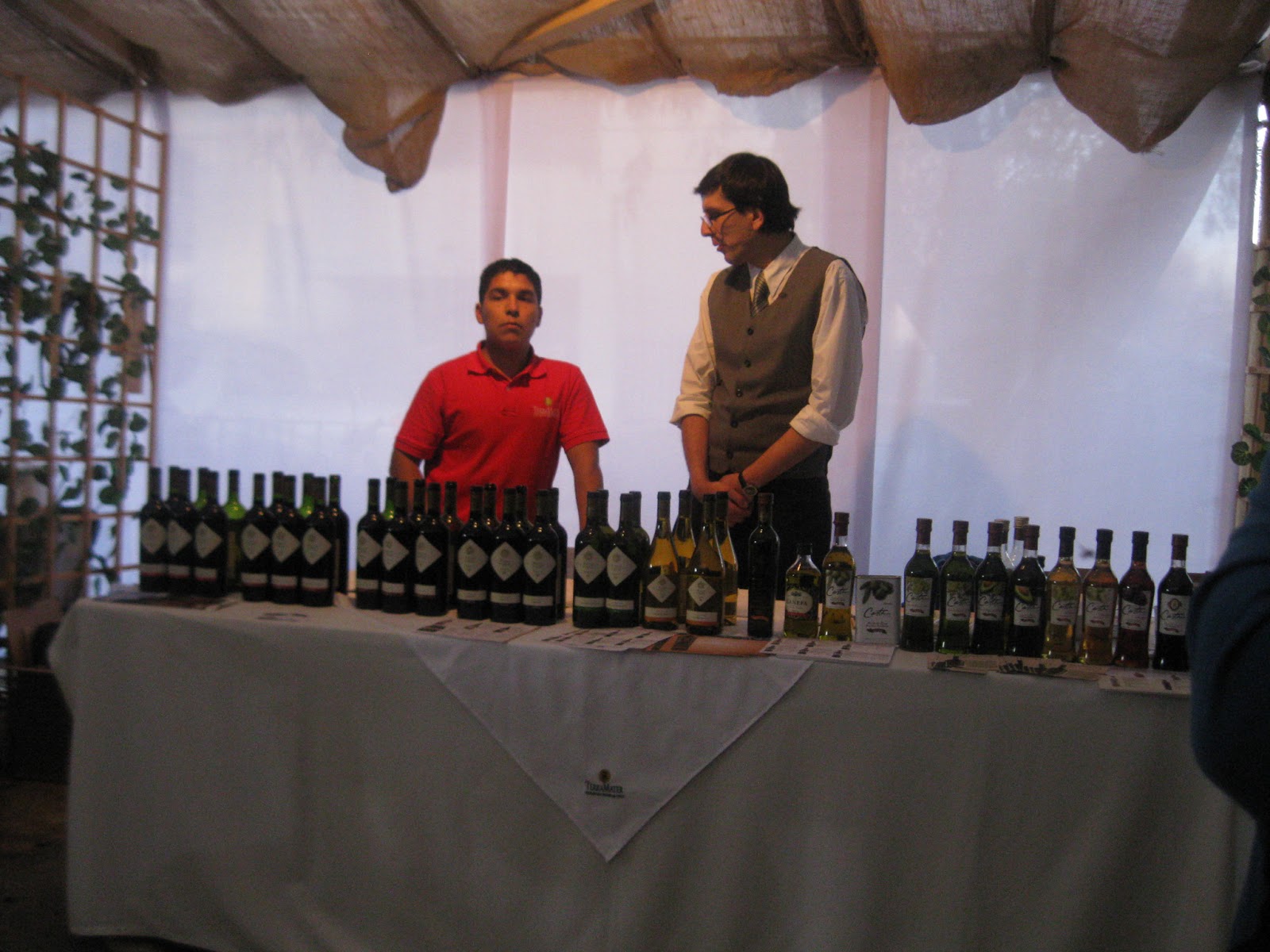
Having dispensed with the preliminary surveying of the grounds, it was time to roll up our sleeves and start appreciating some wine.  The two of us sampled four different wines each that day, always selecting vineyards theretofore unknown to us.

I have to say, unfortunately, that I was unimpressed by all of vineyards save one, Viña Richards.  If I remember correctly we had a Pinot Noir and a Sauvignon Blanc from them, and both were, in a word, tasty.  It's rare to find Pinot Noir in Chile, which was enough for us to gravitate towards it once we noticed it.

It didn't take so long for us to get through our four glasses of wine, moderately portioned as they were.  Afterwards we moved on to the grilled meat section of the festival, where we ate some shish kebab, known locally as anticucho, followed by some larger cuts of chicken and beef.  Damn, that's good!  From this particular angle you can see the meat skewers on the grill, as well as where you stick them once you've picked them clean.  Also featured is our daughter practicing cueca from an unorthodox sitting position.

It might seem antithetical to a celebration like this one, but I saw this brewing company on the way in, and couldn't resist picking up a pint draught on the way back out.  The stout was a fine finish to the evening and kept me occupied for most of the walk to the train station.


We concluded our evening with a sleepy train ride back to Santiago's nicely appointed Estación Central, which connects conveniently to a subway train taking us within two blocks of our apartment.  A fine way to travel, and best of all, the conductor is our designated driver.

You'll have to forgive the low light on this one, but I'd like to think it gives an indication of that soft, warm and fuzzy feeling you get when you ease into your seat on the night train.  It's getting to be vendimia time again in 2013, so I hope to share more soon.

Sunday, September 30, 2012

It's been a long time

Today you're looking at the 51st post I've managed to put together on this blog since I started keeping it, which was, by some stroke of synchronicity, almost exactly five years ago.  That's an average of 10 posts a year, not too bad!


When I think back on five years ago, and read what I was writing then, I realize how so much is different and yet how much is still the same.  Back then, I had recently arrived in Oaxaca, Mexico for the 2nd time, and as my writing was a lot more sporadic at the time, I managed to leave out quite a few of the experiences I'd had there.  So today I thought I'd see how good my memory is as I try to piece back together one of the more interesting excursions I took outside of the city.

This particular day involved a trip stopping off at a number of locations, each one offering a vastly different experience.  The first was at a town politically separate from Oaxaca, although with the urban sprawl of recent years you never really leave what feels like a city before you see this:

This tree, the granddaddy of all junipers, belongs to a species known locally as the ahuehuete.  It's enormous.  It's not the tallest tree in the world, nor is it the oldest.  But its amorphous trunk has the biggest circumference of any known living tree.  As far as I know of, anyway.

It, and a younger specimen of rivaling immensity in the near vicinity, are now located within a populated area known as Tule.  But historically this area, like much of Oaxaca, was a swamp, and this particular swamp as it had once occurred would have been the home to countless such wooden giants, a veritable freshwater mangrove forest of gargantuan proportion.  Today the two millenary survivors are fenced off into well-manicured gardens, where local boys will, for a few pesos, point out some animal shapes in the knobby trunks and branches.  To this end they are equipped with handheld mirrors to bounce some sunlight onto the formations in question, like a low-tech laser pointer.

Once you've had your fill of these massive specimens, you can make your way to Mitla:

Like many Mexican towns, this one bears both a Spanish name and an original name from Pre-Columbian times (albeit hispanicized from its former pronunciation of Mictlán).  Today many of them are known colloquially, more often than not, more by their original name than the Spanish one.  Nonetheless, the Spaniards left an indelible mark on the community of San Pablo Villa de Mitla, which was still populated and in use when the Spanish arrived.  Mitla had been a religious center for the local Mixtec and Zapotec people, and recognized as a gateway between the land of the living and the dead.

As such, there had once been an extensive series of temples and other ceremonial buildings in the community, the walls of which were graced with intricate stonework interlaid without the use of mortar.  These designs were intended at least in part to facilitate the transmission of one's spirit into the next world.

Take, for example, the recurring pattern seen in the middle of this photo. Here we can see a visual representation of one aspect of the Mesoamerican cosmovision.  The staircase represents an individual's ascendance from birth, childhood, adolescence, adulthood and old age. This was followed by the spiraling mystery of existence in the afterlife, only then to be proceeded by another staircase, another life.  Reincarnation!

The Spanish came to such a place and ordered the temples to be dismantled, the stones of which to be incorporated into the church you see above.  Fortunately, not all the temples were needed for that project, and thanks to the lack of mortar, which is more susceptible to erosion, what's left of the temples can still be appreciated today.

After wondering over the silent monuments of (not so) ancient civilizations, you can take a swim in a place known poetically as hierve el agua.  That translates more or less as "The water boils."  I couldn't decide if the water in this shallow pool was really a hot spring, or if the warmth of the water was the product of the perpetually warm Mexican sunshine, and the insulation of the warmed stone beneath it.  Not to mention the further natural heating power of dozens of tourists piling into it every day!

But the real draw of this pool was the incredibly high concentration of mineral content, not the least of which is calcium bicarbonate.  The effect on the bather is the bubbly sensation of soaking in Alka-Seltzer.

You also are afforded, from your perspective in a pool located on the edge of a cliff, a panoramic view of the unspoiled natural landscape all around.  Devoid of any human settlements as far as the eye can see, what you get is a quintessential hot spring experience, as close to nature as a modern human will often find himself.

Before I took a swim myself, I took a quick jog up the hill to see the pools themselves from another vantage.  Here you can see how the cliffside below the pools has accumulated centuries of mineral buildup as water has spilled endlessly over it, like a petrified waterfall.

The trip came to its conclusion with one more stop, this time at a mezcal distillery.

One of the things I suspected through some prior samplings but never knew for sure until I spent some time in Mexico is that I love mezcal.  When it is made well, it has for me a flavor which rivals the complexity of the finest whiskey from either side of the Atlantic, and at a fraction of the price.  It took me awhile to find some mezcal that genuinely belonged to this rarified category, but by my reckoning, Mezcal El Mitleño's top shelf offering, at about $50 a liter, is a fantastic imbibe.  On the other hand, there's a lot of mezcal out there that ought to be reserved for cleaning the floor, so watch out!

Here, we were offered a tour that explained the process of making mezcal.  The first steps are illustrated above.  You cut the leaves respectfully from the agave plant until you are left with a pineapple-shaped core.  This you slice from the earth and cart off to the distillery.

The next thing you're going to want to do is take those big agave hearts, pile them into a big hole on the ground, and smoke them good.   The heat converts the natural starches of the agave into deliciously caramelized sugars available for fermentation, and the technique also imparts onto the final product that magically smoky overtone I've never gotten from any other beverage.

The next step is to grind up the smoked agave into a pulp ready for fermentation, and later, distillation.  Then it's into a barrel with it for at least a year before it's good enough to drink.

At the end of the tour, we got to try the mezcal, and my heart was won by their highest-end bottle, still a steal at the price I mentioned above.  In fact, I bought enough of it to travel with, and I drink it sparingly enough to still have a few ounces left for sharing on a special occasion.
Once armed with a bottle of high-proof drink, and once back in the city of Oaxaca, I was now equipped to embark on one of my other favorite activities in Mexico: street food!  This stand was serving up empanadas de amarillo, which quickly became my preferred main course of any Mexican street food adventure.  It is basically a corn tortilla with chicken and a fantastic sauce of yellow color, hence the name of the dish.

But what really kept me coming back for more of the Mexican food on the street and in the markets was the endless variety available to try, from the well-known tacos, tamales y tortas to some of the lesser-known and exotic preparations: chapulines, huitlacoche, tlayudas, molotes, chochoyones, atoles, pulques, to name a few with no explanation whatsoever.

If you're worried about the safety or cleanliness of what you just ate, don't.  That's what the mezcal is for.  I can tell you after weeks of frequenting countless markets and food stands on the streets of Oaxaca, and always going to a cantina or back home for a shot or two of mezcal afterwards that no harm will come to you if you follow that formula.  And in the process you will have tasted what Mexican food really is, and due to the naturally gregarious Mexican spirit, you will have met plenty of people happy to talk and listen for as long as the meal lasts.

Saturday, August 25, 2012

Last stop, Pucón


Pucón, the final destination on our tour of southern Chile (and a bit of Argentine Patagonia).  It's a popular vacation spot for Chileans, and why not?  With a beautiful lake, a snowcapped volcano on the horizon  -complete with a visible fumarole billowing from its cone - and surrounded by forest, rivers and hot springs, it's got a lot to offer.  Plus, it's only about eight hours from Santiago.

Rather than coming from our home in Santiago, however, we took the long way around, having come straight from San Martín de los Andes in Argentina. On the way we were afforded a view of yet another snowcapped mountain, not to be confused with the one pictured above.  In the foreground is a group of prehistoric-looking monkey puzzle trees, also known as the Araucaria, Chile's national tree.

It was another long ride, and a steady ascent up the Argentine side of the Cordillera de los Andes, until the border defined by the continental divide.  Then came the ear-popping descent on the other side, through a river valley bottoming out at the lake region of Pucón itself.

As had been the case with all of our previous stops throughout the south of Chile, we were in direct competition with every other vacationer making their way around the southern regions of the country.  In order to avoid getting stuck without a ride or a place to stay, we had settled into a successful routine of buying departing bus tickets from each town as soon as we arrived there, and making hotel reservations even further in advance.

Pucón's proximity to Santiago, though, and it being one of the last weekends of summer vacation for most schools and universities, foiled our ordinary system. Every hotel I tried to call was already booked more than a week in advance, so we had no choice but show up and try our luck.  Fortunately, though, we weren't put out for long.  A few blocks from the bus station was a new hostel, with roughed-in rooms still smelling of fresh-cut, unfinished lumber.  Having just opened for business, it was nowhere to be found on any list online or in print, and so walk-up clients like us were their only income.  Nonetheless, it was a full house during most of our stay.

Easily explained by views like this and the many adventure sports that come with them, we arrived in Pucón to discover that every ticket on every bus leaving town for the next week was already sold.  It looked like a nice place, but a week in town was more than we bargained for.  Again, however, we were in luck, as there was one exception: two first-class tickets on an overnight bus, in four days.  They weren't cheap, but they would put us back home right when we wanted to be there, and we'd have plush seats that folded down into beds, complete with pillows and blankets for the night's ride.  It was an offer we couldn't refuse.

With all the hard work out of the way, we could now set our minds at ease and get down to the real business of being here.  The first stop was the lake, and its black sand beaches, with the backdrop of wooded mountains, under a cloudless sky.  Ah, Chile!


We haven't been to any town in Chile that hasn't featured some playgrounds for kids, either.


The next day we woke up early to visit Huerquehue national park.  One of the first features we came upon was Tinquilco lake, a long slender body of water with a camping area and even a couple of rowboats.


El lago Tinquilco, y el volcán Villarica, from a privileged vantage.


A candid glimpse of a human animal, in its natural element.


On the third day we visited a resort called Peumayén, several kilometers away from Pucón.  It offers hot springs like these along a river, as well as a more developed bath house up the hill.


There was also a trampoline, and a friend.


With a rustic restaurant as well, it was a fine place to spend the day, have a soak, eat lunch, and otherwise enjoy some time outside in the mild southern Summer.


Picking blackberries while waiting for the bus back to town.


The last day we spent in Pucón.  The weather wasn't looking very good, but we couldn't resist the opportunity to take a boat tour on the lake.


Keeping warm, and out of the rain.


The weather sure changes fast around here.  Also featured in this photo is some of Pucón's more exclusive real estate.  Apparently there's a private golf course on the other side of the hill.


It was the end of the day, and the end of our trip.  Soon we'd get on the last of countless buses we'd taken throughout our extended trip around some of the most beautiful countryside I've seen.  Of the many towns we'd visited, Pucón was perhaps our favorite.  A great place to mark the end of a vacation I'll never forget.

Sunday, July 29, 2012

San Martín de los Andes

Today's post, like our stop in San Martín of Argentina, is perhaps too short.  Our friends Clint and Pía live there with their son Ollie, just a few months younger than our Tamia.  It was great to see them, share some time together, and see their new setup in Argentine Patagonia:

The way there took us along a highway known as the carretera de los siete lagos.  We counted seven lakes, sure enough.  And lots of mountains.  What a great combo.  Well done, Patagonia.  Well done.


The last time they saw each other, neither could walk yet.  Now it's hard to get them to stop...


Morning at the beach, and the freedom of expression.


A candid shot of nuns sharing some yerba mate.  Click on the photo, zoom in, and look closely.  Nuns.  Drinking mate!  All the rumors about Argentines' love for mate were proven true in San Martín.  I've never seen so much mate consumption.  It's a way of life.  And one that I approve of.  Hopefully a trip to Buenos Aires will be in our future, for some further field research into the phenomenon.


Keeping it real.

Thanks for the good times, our dear friends.  This little story is a tribute to you.  Not shown in this short glimpse of life in San Martín are Argentine microbrews, late night cribbage, spontaneous burgers, and volcanic ash.  But all that and more transpired in the course of 48 hours, before we got back on a bus and said goodbye to them, and to Argentina.  Until next time!

Saturday, June 30, 2012

Beautiful Bariloche


It was a long ride, but eventually, we arrived: Bariloche, in Argentine Patagonia.  Bariloche is the kind of town that really symbolizes an entire region, conjuring up many images of Patagonia upon simply hearing its name. It is a destination unto itself, a community many travelers are moved to visit almost as a place to check off a list of important stops on a grand South American tour.  When we began our trip, Bariloche wasn't on our own personal list of places to see, but once we decided to include Argentina in the loop, we couldn't resist putting it squarely on our path.

To get there, we crossed over the Cordillera de los Andes, the continental divide of South America, and the border between Chile and Argentina.  With it came too the protracted wait at checkpoints on either side of the border.


We also had the chance to see firsthand the otherworldly effects that the eruption of the volcano Puyehue has had on the surrounding landscape.   Ash has piled up relentlessly on the ground, in the branches of trees, and on the roofs of buildings, like grey snow that will never melt.


And after nearly a full day of being on a bus, we were there.  As the blue waters of Nahuel Huapi lake came into sight for the first time, I admit I was happy to be finishing with such a long ride.  The scenery had been incredible along the way, changing constantly as we went.  But once we were off the bus and making our way into town, it was liberating to have such a long trip behind us, no matter how picturesque it had been.  It wasn't long before we were looking over the lake from this vantage point, the apartment we rented for our stay.

After so many times calling ahead for our accommodations for the next destination, we decided to play it by ear in Bariloche, what with the dozens of places to stay that were to be found in every travel guide and website we looked at.  In the end, for the same price we'd pay at a hotel, we had our own place with a private kitchen and a view.  Not too shabby!

Once we were set up with a place, we headed out for the evening for some pizza, followed by some looking around.  After dark, the summer heat gave way to the cold mountain air.  We hadn't packed much in the way of warm clothes, but it turns out that Bariloche is something of a shopping capital of Patagonia.  The main emphasis was handcrafted chocolate, but there were plenty of clothing stores to be found as well.  After fortifying ourselves with a little of both, we were equipped for the night and the festivities that came with it.

By chance, we found ourselves in Bariloche for the weekend of Carnaval, the feast of Catholic binging prior to the pious period of Lent to be ushered in with the coming Ash Wednesday.  A tradition with a history nearly as long as Lent itself, nearly all countries with a Catholic tradition have their own version.  Ecuador certainly does, as I've experienced before.  I don't know how representative Bariloche is of Argentina as a whole, but the community here was doing its best to drum up *ahem* some Carnaval parading in the festive tradition I saw in Ambato.  While these kids were dressed a bit more warmly that what you might find in more tropical places like Ecuador, or Rio de Janeiro, they did a fine job ringing in the Lenten season.

Some more Argentine food, a bit more consumerism, and sadly, our time in Bariloche came to an end as quickly as it started.  Or not so sadly, really, as the road ahead led to old friends in another town in Argentine Patagonia.  One more stop on our tour of the Southern Cone!